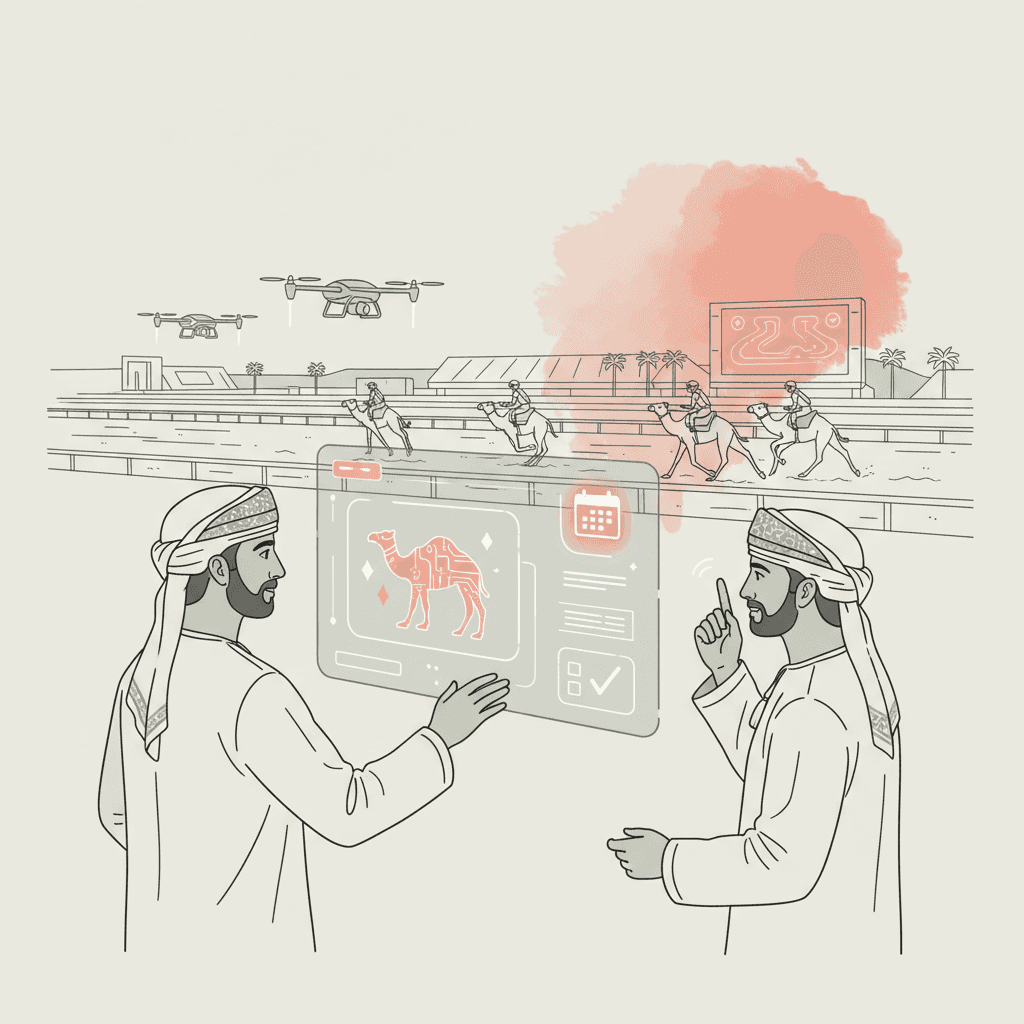
Omani Federation “Hybrid” Race – January 2026
Race Format and “Hybrid” Structure
Despite the term “hybrid” being used, this event is a traditional in-person camel racing festival rather than a hybrid physical/virtual run. In context, “hybrid race” refers to Oman’s heritage camel races (the Arabic word “hijin” for racing camels was mistranslated as “hybrid”). All races occur live on the track with trained racing camels; there is no virtual participation for remote runners or cyclists. However, the Federation often broadcasts the races and results to the public, allowing fans to follow remotely. Modern technology is integrated through the use of robotic jockeys (remotely controlled riding devices) on the camels, except for a few special rounds with human jockeys. Overall, the event’s format is an on-site camel racing competition, celebrated as a sporting and cultural festival in person.
Race Categories and Distances
Each day of the meet features multiple race categories based on the age class of the camels, with set distances for each:
-
Haqa’iq (young camels ~2 years old) – ~4 km races (Day 1). The opening day has 34 rounds of 4 km races for this category(split into morning and evening sessions).
-
Laqaya (3-year-old camels) – ~5 km races (Day 2). The second day runs 24 rounds of 5 km races for the Laqaya category.
-
Yithaa (4-year-old camels, also called Al-Yadha’) – ~6 km races (Day 3). The third day includes 14 rounds of 6 km races in this class.
-
Thanaya and Houl/Zamoul (older camels, 5 years and up) – ~8 km races (Day 4). The final day features 8 km races (12 rounds) for the Thanaya (five-year-olds) and Al-Houl/Al-Zamoul (six-year-old and older) camels n addition, special short races (2 km) with human jockeys riding camels are held on the final day – one in the morning for Zamoul camels and two in the evening for Thanaya/Houl – as a nod to tradition.
Each category’s races are run in multiple rounds (heats) given the large number of participating camels. For example, the Haqa’iq 4km races alone are split into 34 separate heats on Day 1 This packed program ensures excitement across all four days, with hundreds of camels competing. The structured distances per age group are designed to match the camels’ capabilities – shorter distances for the youngest camels, and longer distances (up to ~8 km) for the mature camels in the final rounds.
Participation Eligibility
Who can participate: Entry is restricted to registered camel owners and their racing camels under the Federation’s rules. Notably, only purebred racing camels owned by Omani nationals are allowed to compete. The Oman Camel Racing Federation requires that all participating camels be properly registered and fitted with an official electronic microchip ID. Each camel is categorized by age to compete in the appropriate distance class as listed above. Professional trainers (mudammir) typically handle the camels, and the events draw camel owners from all over Oman to enter their best racing camels.
Age groups: Unlike foot races that have human age brackets, here the “age groups” apply to camels. The categories (Haqa’iq, Laqaya, Yithaa, Thanaya, Houl/Zamoul) correspond to increasing age (from roughly 2-year-old camels up to 6+ years) and determine the race distance This system ensures camels compete against others of similar age and development for fairness and safety.
All participants (camel owners) must also adhere to strict Federation regulations. Doping or illegal aids are explicitly prohibited – the use of any stimulants or electric prods is banned and can lead to disqualification. Furthermore, camels are subject to veterinary checks before each race to ensure they are fit to race. In recent years, Oman has also enforced the use of robot jockey devices (in place of child jockeys), improving safety and ethics in the sport. The only exception is the few exhibition rounds where adult riders participate, as mentioned for Day 4.
Overall, eligibility is limited to the community of camel owners and breeders within Oman, reflecting the sport’s deep roots in Omani culture. Spectators are welcome to attend, but the actual race participation is for camels and their handlers rather than the general public.
Registration Process and Deadlines
Registration for the event is managed by the Oman Camel Racing Federation through its electronic registration system. Typically, entries for such races close a few days prior to the start to allow time for organizing heats and conducting health inspections. On race days, officials verify each camel’s identity (via microchip) and health status. Camels without the required microchip ID and veterinary clearance are not allowed to compete. This ensures the integrity of the competition and the welfare of the animals.
Fees: There was no entry fee mentioned for participating in the federation’s annual camel races. Generally, these events are government-supported sporting competitions (with significant sponsorship), so owners can enter their camels free of charge upon meeting the qualification criteria. The focus of registration is on compliance with rules rather than payment – for example, ensuring all camels are properly identified and drug-free. Any nominal fees (if required for registration processing or membership) were not highlighted in official announcements, suggesting that the process is largely subsidized. In summary, registration is mandatory but at no explicit cost, and must be completed in the official system before the event.
Sponsors, Prizes, and Cultural Initiatives
This annual race festival is both a sporting competition and a cultural heritage event. It is conducted under the auspices of the Ministry of Culture, Sports and Youth, reflecting Oman’s commitment to preserving camel racing traditions. The Oman Camel Racing Federation also partners with private sponsors to support the racing season. Notably, for the 2025–26 season, companies like Shell Oman and Occidental Oman (Oxy) have sponsored certain race meets. These sponsorships provide prizes and logistical support; for example, Shell backed races in October in Al Dakhiliyah and Al Dhahirah, and Oxy sponsored events in Al Wusta and other regions. Such partnerships are part of Oman’s initiative to engage the private sector in sustaining traditional sports.
Prizes: The stakes are high for top competitors. The Federation confirmed that the top 10 winners in each race (each round/category) receive cash prizes, and many rounds offer high-value in-kind prizes to the champions. These often include new 4x4 vehicles (such as Toyota Land Cruiser SUVs) for the winners of major rounds, which is a common grand prize in Gulf camel races. In addition, winners may be awarded traditional Omani symbols of honor like khanjars (ceremonial daggers), swords, and trophies in certain prestigious races. For the 2026 annual festival, local news hinted that a Toyota Land Cruiser is among the grand prizes for the festival’s top race. In summary, the Oman Camel Racing Federation’s mid-January 2026 hybrid (camel) race is a four-day national camel racing festival. It will take place Jan 18–21, 2026 (venue to be announced)
Related pulses
Tamkeen Forum in South Al Batinah Promotes Functional Proficiency and Sustainable Institutional Impact
The "Tamkeen" forum commenced in Al Rustaq, South Al Batinah Governorate, under the slogan "Functional proficiency towards sustainable institutional impact." Organized by the Directorate of Endowments and Religious Affairs, the forum's activities aim to enhance professional skills and achieve lasting organizational results. The event began on Monday at the office of the Wali of Al Rustaq.
Al Dakhiliyah Governorate Discusses Mechanisms for Developing Beneficiary Experience and Enhancing Service Quality
Al Dakhiliyah Governorate discussed mechanisms for enhancing the beneficiary experience and improving service quality. The discussions, held on Tuesday in Nizwa as part of the "Second Customer Service Forum," focused on utilizing digital transformation and data to optimize services and support decision-making processes.
For the First Time in Oman: Elīna Garanča Performs an Exceptional Show at the Royal Opera House
The renowned international mezzo-soprano Elīna Garanča performed an exceptional concert last Friday. The Royal Opera House Muscat hosted Garanča for her inaugural appearance in the Sultanate, marking her first performance in Oman.